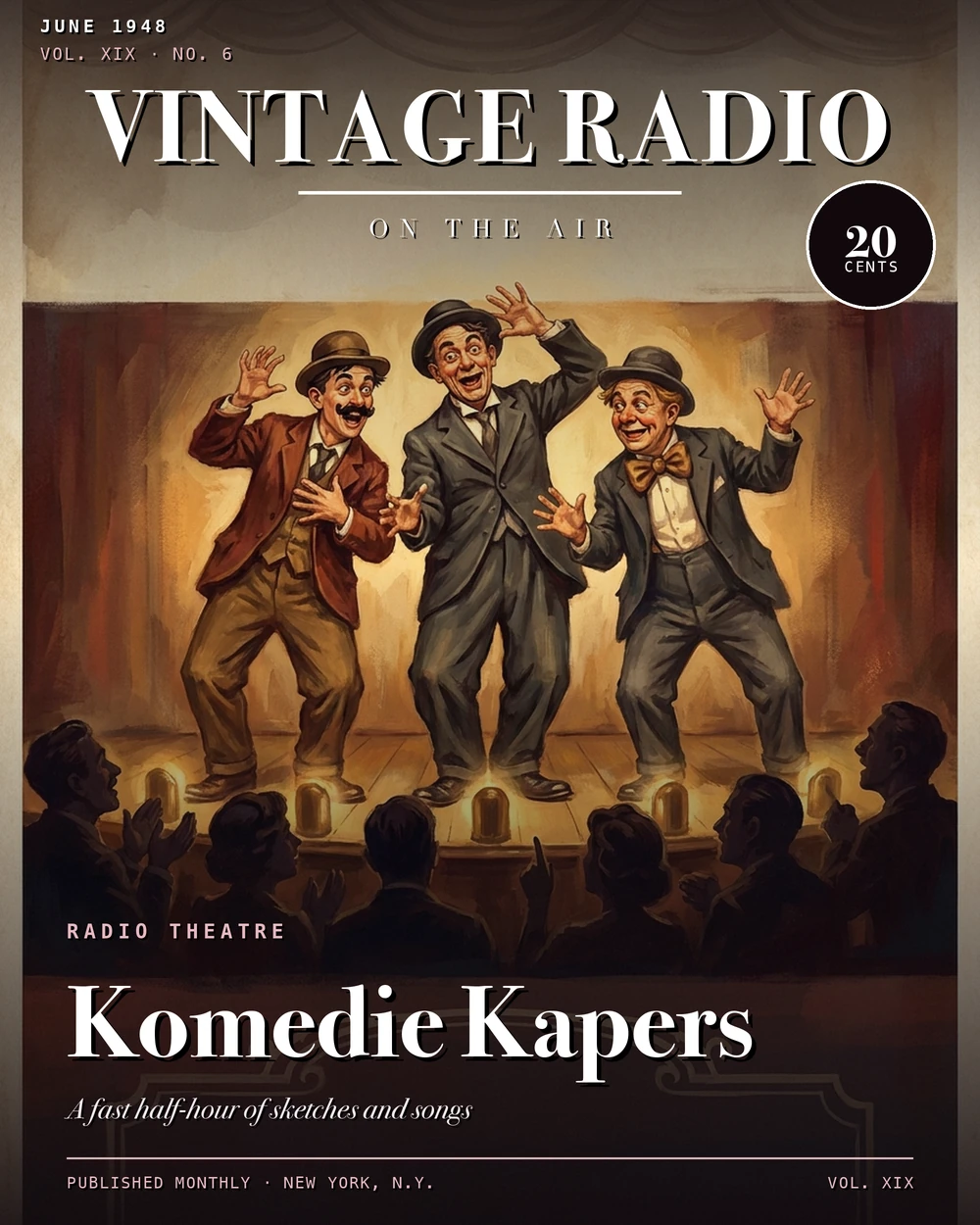
Komedie Kapers
A Comedy Show Built Around a Single Idea Per Episode
Komedie Kapers had a simple structural hook that gave it shape: every episode was built around a single overriding theme. One week it was Wishes. The next it might be Picnics, or Cynics, or Sleep, or Fraternities. The songs, the skits, and the jokes all had to fit that theme, which gave the writers something to push against and gave listeners a loose sense of what kind of comedy was coming. It's a format that sounds obvious in hindsight but took real discipline to pull off consistently across a run of dozens of short episodes.
Each episode ran roughly 14 to 15 minutes — tight, self-contained, and clearly designed for syndicated broadcast rather than a single network slot. The length suited the format. There was no room for long setups or character development, which pushed the writing toward punch lines, banter, and quick sketch transitions. The vaudeville influence is easy to hear in that structure: get in, make the audience laugh, get out.
The show was produced and distributed by Broadcasters Program Syndicate, operating out of Hollywood under the name Bruce Eells and Associates. The company was active from the mid-1930s onward and distributed comedy, drama, and variety programs to stations across the country. A Library of Congress finding aid covering the Transco/Bruce Eells papers documents the operation from 1931 through 1952, which places Komedie Kapers squarely in the early years of that outfit's output.
Tom Post, Bob Burns, and the Show's Comic Core
The host of Komedie Kapers was Tom Post, who anchored the sketches and carried the through-line of each themed episode. Alongside Post, radio comedian Bob Burns appeared in many episodes — and that association gives the show a historically grounded foothold in American comedy.
Burns, who came from Van Buren, Arkansas, built his stage persona around hillbilly storytelling and homespun humor. He was known as "The Arkansas Traveler" and "The Arkansas Philosopher," and he was famous for playing a novelty instrument he invented himself, which he called the bazooka — a name that later attached itself to the World War II rocket launcher, reportedly because some soldiers thought the weapon resembled it. Burns lived from 1890 to 1956, and his national radio breakthrough came in 1935 when he appeared on Paul Whiteman's coast-to-coast program. His work on Komedie Kapers predates or coincides with that national exposure, which makes his appearances here part of the early chapter of a career that would eventually reach wide audiences.
Beyond Post and Burns, the show featured an ensemble of voice actors and comedians, with rotating guest stars brought in to keep individual episodes fresh. The cast mixed recurring characters with newly invented ones depending on what the week's theme demanded — a flexible arrangement that suited a syndicated comedy with a tight runtime and a wide range of topics.
What Survives and What the Episodes Cover
The episode catalog contains 48 episodes, though the run almost certainly extended further. A note from Audio-Classics.com indicates the program underwent a slight format change beginning with episode 50, which suggests the total output went well beyond what the current catalog holds.
The surviving titles give a good picture of the show's range: Good Intentions, Grass Bachelors, Coeds, Weather Prophets, Speed, Dixie, Finances, Hot Tamales, Bell Hops, Real Estate, Visitors. The topics are ordinary and familiar — the kind of subjects a 1930s audience would recognize from daily life — which fits the show's vaudeville-inflected approach. Comedy built on the familiar doesn't require explanation; the audience is already in on the premise.
Multiple OTR research sources consistently place the show in the mid-1930s, around 1934 to 1935, in line with the episode record. References to 1934 episodes have appeared in podcast listings covering the show, and the 1935 dates in the episode record line up with what's known about Bob Burns's career timeline and the activity of Bruce Eells and Associates during that period.
The Humor and Its Era
Komedie Kapers drew on a sketch comedy sensibility that mixed slapstick with witty banter, toggling between physical comedy translated into audio terms and the rapid-fire joke exchanges more typical of vaudeville-style radio. The show's humor ranged across that spectrum depending on what the theme called for.
Some of the comedy in the show reflects the racial and ethnic stereotyping that was common to 1930s entertainment. The surviving episodes include material involving derogatory portrayals of African-Americans, Southerners, and Chinese people. That's part of the historical record of how American comedy operated in this era, and listeners approaching the show today will encounter it. The humor that holds up best is the wordplay and the character-based sketch work, which ages more gracefully than the material that leaned on stereotype for its punch lines.
The show's place in the mid-1930s comedy landscape was as a syndicated variety program — not a flagship network production, but a working piece of the radio ecosystem that gave comedians like Burns a regular outlet and gave stations around the country affordable, formatted comedy content they could slot into their schedules.